
Organize Systems, Not People: Build a Better Auto Repair Shop
Oct 13, 2026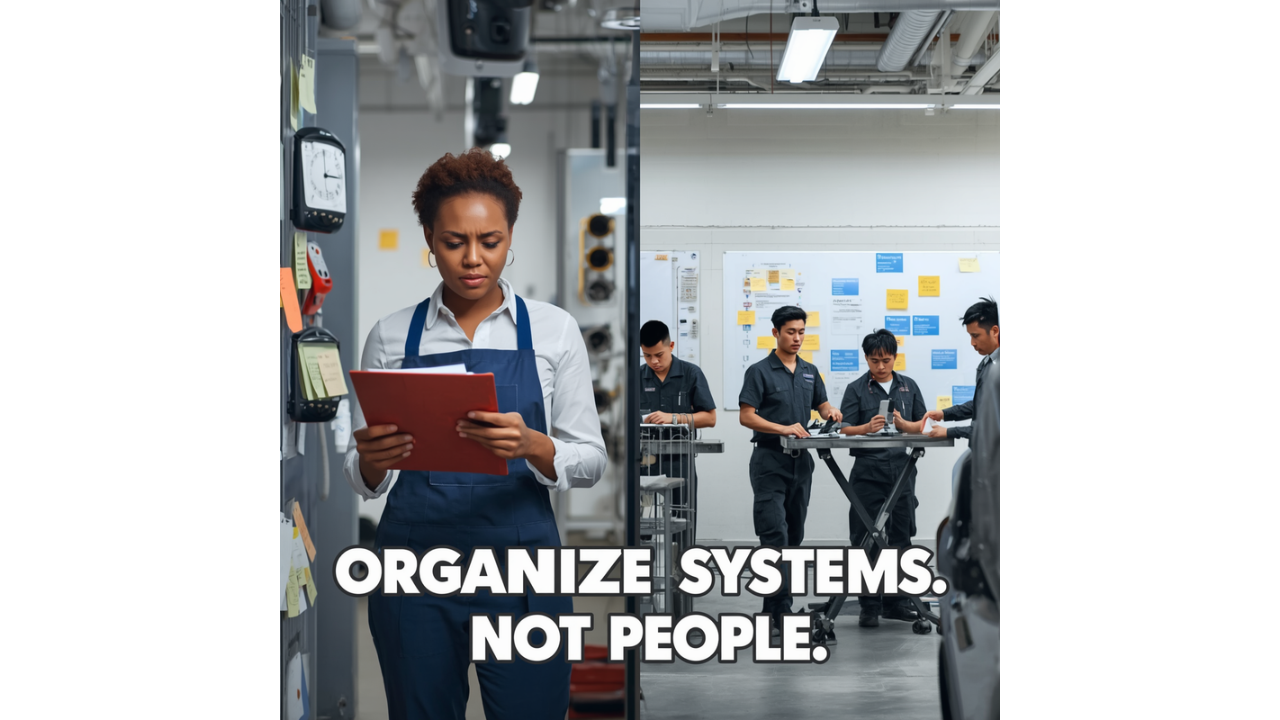
The Point: Your People Aren't the Problem. Your Systems Are.
If your auto repair shop only runs smoothly when you're standing in the middle of it, you don't have a people problem.
You have a systems problem.
Too many shop owners spend their days managing every move their employees make.
They tell technicians which vehicle to work on next. They remind service advisors to call customers. They chase parts, double-check repairs, and answer the same questions day after day.
Then they wonder why they're exhausted.
Here's the problem.
Good employees shouldn't need constant direction to do work they've already been trained to do.
They need clear expectations, consistent processes, and a way to know what happens next.
Your job as a shop owner isn't to control every movement. It's to build a business where the right things happen without you constantly pushing everyone forward.
Stop organizing people. Start organizing the systems they work within.
Here's what that looks like inside a real-world auto repair shop.
The Story: The Shop Owner Who Became Everyone's Boss, Dispatcher, and Problem Solver
Picture a busy European auto repair shop.
Six technicians. Two service advisors. A shop full of BMWs, Audis, Mercedes-Benz vehicles, and Porsches.
From the outside, business looks great.
The parking lot is packed. The phones keep ringing. Customers are booking appointments two weeks out.
But inside the shop?
It's controlled chaos.
At 8:15 Monday morning, a technician asks the owner which car he should work on first.
At 9:00, a service advisor needs to know whether to order parts for an Audi A6.
At 10:30, another technician is waiting for approval on a BMW water pump replacement.
By lunchtime, the owner has answered 25 questions, resolved four scheduling conflicts, and dealt with an upset customer who never received an update about a parts delay.
And he hasn't accomplished a single thing to grow his business.
Sound familiar?
Like many shop owners, he assumes his employees are the problem.
"They need to take more initiative."
"They should already know what to do."
"Why does everyone need me to make every decision?"
So he doubles down.
More morning meetings. More reminders. More checking up on people.
He starts walking through the shop every hour, making sure everyone is working.
And somehow, productivity gets worse.
Technicians hesitate to make decisions because they're worried about getting blamed if something goes wrong.
Service advisors wait for approval because nobody has clearly defined what they're authorized to handle.
Every little issue eventually makes its way back to the owner's desk.
Without realizing it, the owner has trained his entire team to depend on him.
He's become the bottleneck in his own business.
One Question That Changes Everything
Now imagine he approaches the problem differently.
Instead of asking, "How do I get my people to work harder?" he asks something far more useful.
"What part of our process forces people to come to me?"
That question changes how he sees his shop.
Over the next week, he watches where work slows down, where decisions get delayed, and where employees need unnecessary approval.
Three problems keep showing up.
First, technicians don't always know which vehicle takes priority.
Second, parts approval is inconsistent. Sometimes service advisors order parts without hesitation. Other times, they wait for the owner's permission.
Third, customer communication happens whenever somebody remembers to make the call.
None of these problems comes down to employees being lazy.
They're problems with the way the shop operates.
So the owner puts three simple systems in place.
System 1: Make the Workflow Visible
Every repair order gets a clear status, priority, and assigned person responsible for the next step.
Technicians know what they're working on, what's coming next, and what's holding up a job.
There's no guessing and no wandering around looking for direction.
System 2: Define Who Can Make Decisions
Service advisors receive written guidelines explaining which decisions they can make independently and which require management approval.
Routine situations stop turning into interruptions.
The owner is still involved when necessary, but he's no longer the automatic answer to every question.
System 3: Standardize Customer Updates
The shop establishes specific points in the repair process when customers must receive updates.
When a repair is delayed, customers hear about it before they're forced to call and ask.
Communication becomes part of the workflow instead of something employees squeeze in when they remember.
The Results: Less Chaos, More Ownership
No expensive software overhaul.
No 40-page operations manual.
Just three clear processes that make everyone's job easier.
Consider what happens if those changes eliminate ten unnecessary interruptions every day.
At five minutes per interruption, that's 50 minutes of the owner's time recovered daily.
Over a five-day workweek, that's more than four hours.
And that doesn't even account for technicians who are no longer waiting for direction, advisors who can move repairs forward faster, or customers who aren't calling repeatedly for updates.
The potential gains go well beyond the owner's schedule.
The biggest change is ownership.
Employees start making decisions within clear boundaries. Problems get resolved closer to where they happen. Work moves forward without someone constantly checking on everyone.
The shop becomes calmer and more predictable.
And the owner can finally spend more time leading the business instead of acting like a human traffic controller.
That's what happens when you organize systems instead of constantly organizing people.
The Lesson: Five Steps to Build a Shop That Doesn't Depend on You
Your employees don't need another lecture about stepping up.
They need an environment where doing the right thing is easier than doing the wrong thing.
Strong auto repair shop systems create that environment.
Here's where to start.
1. Identify the Interruptions That Keep Repeating
For the next five business days, write down every question or problem that pulls you away from your responsibilities.
Pay attention to the repeat offenders.
If the same question comes up three times, there's a good chance your shop needs a clearer process.
Don't automatically blame the person asking.
Fix the reason they have to ask in the first place.
2. Make Your Workflow Visible to Everyone
Every employee should be able to answer three questions without tracking down the owner:
-
What's happening right now?
-
What needs to happen next?
-
Who is responsible for the next step?
If those answers aren't obvious, employees will develop their own ways of getting work done.
And eight employees following eight different processes is a recipe for confusion.
3. Give Employees Clear Decision-Making Authority
Define which decisions technicians and service advisors can make independently.
Make it clear when they need approval and who provides it.
Put those boundaries in writing so expectations are consistent.
Responsibility without authority creates frustration.
When people know what they own, they're more likely to take ownership of it.
4. Replace Constant Supervision With Simple Checkpoints
Stop interrupting your employees every hour to see whether they're productive.
Instead, establish a short morning meeting, visible repair order statuses, and a quick end-of-day review.
These checkpoints help identify problems without creating unnecessary interruptions.
Manage the process.
Coach the person when needed.
There's a big difference between accountability and micromanagement.
5. Improve One Shop System Every Week
Don't try to rebuild your entire operation over a weekend.
Choose one frustrating bottleneck.
Create a straightforward process to solve it.
Train the team, test the process, and see whether it works.
Then move on to the next problem.
Consistent improvements to your repair shop operations will accomplish more than another month of putting out the same fires.
Your Five-Minute Shop Systems Check
Before you leave the shop today, ask yourself:
-
What question did I answer more than once?
-
Where did work stop because someone needed permission?
-
Which customer update almost got missed?
-
What responsibility would fall apart if I took Friday off?
Pick the biggest issue.
Create one clear rule, checklist, or process that prevents it from happening again.
Then measure whether the interruptions decrease.
That's how you start building a shop that operates with less confusion and greater accountability.
Micromanagement creates dependence. Clear systems create independence.
The goal isn't to build a business that runs without people.
It's to build a business where good people can do great work without constantly needing the owner to tell them what to do.
And when that happens, the owner finally has the freedom to focus on growing the business instead of simply surviving another day.
Ready to Stop Being the Bottleneck in Your Own Shop?
A busy shop doesn't have to be a chaotic shop. With the right systems, your team can take ownership, productivity can improve, and you can start getting your time back.
Join GO FUEL Coaching at gofuelcoaching.com to learn how to build practical systems, develop stronger leadership, and run a more profitable auto repair business.
Get your copy of The Professional Advantage. Discover the leadership principles and business strategies that help automotive shop owners build stronger teams and better businesses.
Get The Shop System Bundle. Your must-have resource for creating clear processes, improving accountability, and bringing consistency to your automotive repair shop.
Book a One-on-one implementation session with Eric. Stop collecting ideas and start putting systems into action that help your shop operate more efficiently and make more money.
Stop managing every move. Start building a shop that moves forward without you.
If you’re tired of feeling like your business is running you instead of the other way around…
👉 Book your free strategy call here — together, we’ll uncover the simple shifts that can take your business from good to exceptional.